
Table of Contents
The aviation industry in 2026 is facing significant aviation tort liability challenges as technology evolves
As the world transitions toward autonomous flight systems, urban air mobility, and next-generation propulsion, the framework of aviation tort liability has become more complex than ever.
At Elite Tort Claims, we specialize in dissecting the intricacies of flight litigation, ensuring that corporate accountability remains the bedrock of global air safety.
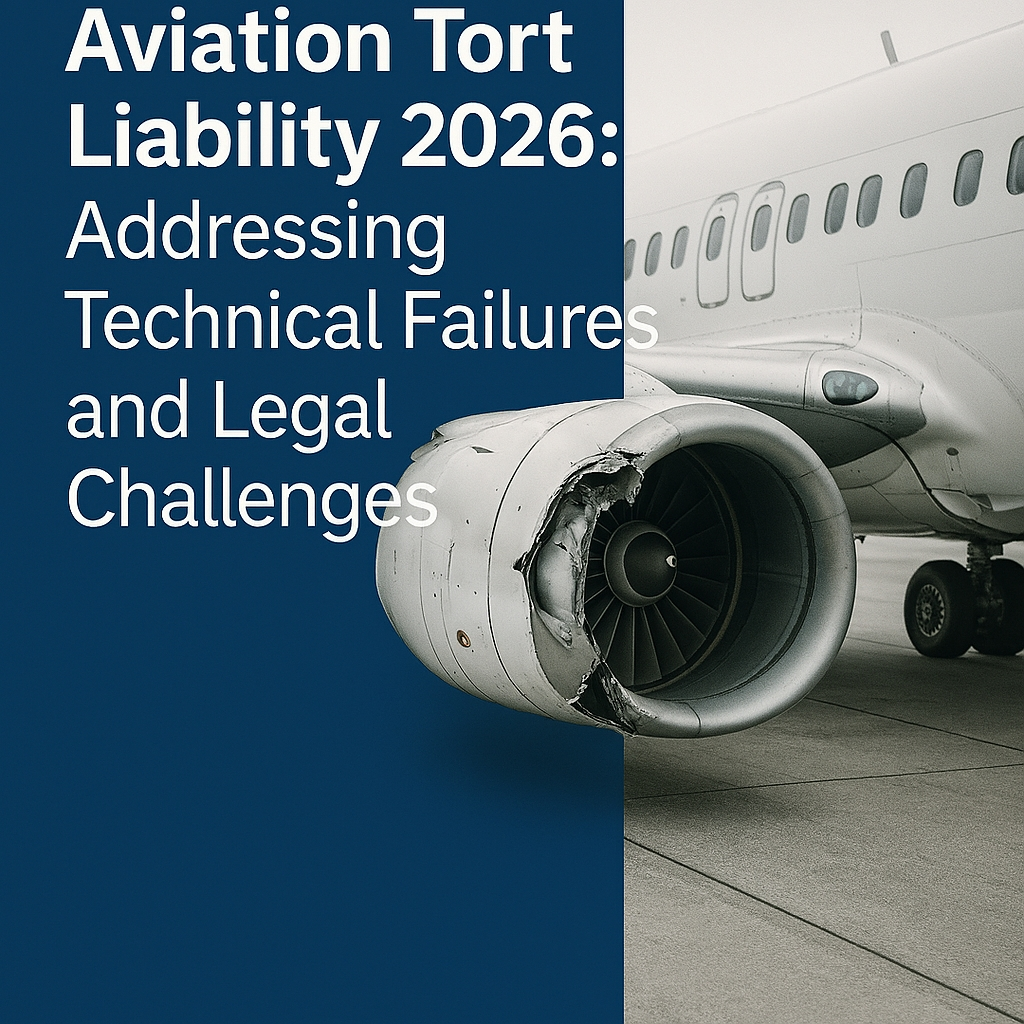
In 2026, aviation tort liability is no longer defined solely by traditional pilot error.
Instead, it encompasses a broad spectrum of professional negligence, ranging from software malfunctions in flight control systems to systemic failures in maintenance protocols.
For legal teams, establishing legal accountability in the wake of an aviation incident requires a multidisciplinary approach, blending forensic engineering with a deep understanding of international safety standards.
The Shift Toward Algorithmic Accountability
One of the most profound changes in aviation tort liability this year is the rise of “algorithmic negligence.
“With AI now managing significant portions of flight paths and emergency responses, the legal focus has shifted toward the developers and manufacturers of these systems.
If a technical failure occurs due to a flawed algorithm, the aviation tort liability may be shared between the airline and the software provider.
Strategic liability oversight is essential to untangle these digital webs and ensure that victims receive fair compensation for failures in automated safety protocols.
Technical Failures in Next-Gen Propulsion
As the industry moves toward electric and hydrogen-powered aircraft in 2026, new categories of technical failures have emerged.
Battery thermal runaways and cryogenic fuel leaks present unique risks that traditional aviation tort liability laws were not originally designed to handle.
Proving professional negligence in these cases involves auditing the manufacturer’s testing data against modern safety standards.
This intersection of green technology and legal risk management is a primary focus for high-stakes litigation in the mid-2020s.
The Role of Strategic Legal Risk Management
To navigate the turbulent waters of modern litigation, airlines are increasingly relying on Strategic Legal Risk Management.
By implementing real-time data streaming and predictive maintenance, firms can identify potential risks before they manifest as catastrophic events.
In the context of aviation tort liability, a company’s failure to act on predictive data can be used as clear evidence of professional negligence, significantly increasing their legal exposure during a trial.
International Jurisdictional Challenges
Because aviation is inherently global, aviation tort liability cases in 2026 often span multiple continents.
A technical failure in a plane manufactured in Europe, operated by an Asian airline, and involving American passengers creates a jurisdictional nightmare.
Successful litigation requires a mastery of the Montreal Convention and other international safety standards to determine where legal accountability should be settled.
This globalized nature of flight law makes aviation tort liability one of the most lucrative and complex fields for international law firms.
Successful litigation requires a mastery of the Montreal Convention and other international safety standards to determine where legal accountability should be settled.
This globalized nature of flight law makes aviation tort liability one of the most lucrative and complex fields for international law firms.
Maintenance, Repair, and Overhaul (MRO) Negligence
A significant portion of aviation tort liability claims in 2026 stems from outsourced maintenance.
When an airline hires a third-party MRO provider, the lines of corporate accountability can become blurred.
If a technical failure is traced back to an improperly installed component, the strategic liability oversight must determine if the airline exercised due diligence in supervising the contractor.
Professional negligence in the hangar is just as dangerous as negligence in the cockpit, and the 2026 legal landscape is increasingly unforgiving of these oversight failures.
Passenger Protection and Mass Tort Litigation
When a commercial flight incident occurs, it often triggers massive Product Liability Claims against aircraft manufacturers.
These mass torts involve hundreds of plaintiffs seeking redress for the same technical failure.
In 2026, the success of these cases depends on the ability to prove that a manufacturer prioritized cost-cutting over established safety standards.
Aviation tort liability specialists work to consolidate these claims, ensuring that the collective voice of the victims forces a higher level of corporate accountability across the entire aerospace sector.
Data Privacy and Cyber-Liability in Flight
As aircraft become “flying data centers,” cybersecurity has become a core component of aviation tort liability.
In 2026, a cyber-attack that causes a technical failure or a loss of flight control is treated as a major breach of safety standards.
If an airline’s systems were found to be vulnerable due to outdated security protocols, they face severe legal accountability for professional negligence.
This new frontier of “Aero-Cyber Law” is rapidly expanding, creating a high demand for experts who understand both aviation physics and digital security.
The Impact of Space Tourism on Aviation Law
Looking toward the end of 2026, the boundary between the atmosphere and space is blurring with the rise of commercial space tourism.
The aviation tort liability framework is currently being adapted to cover suborbital flights.
This transition introduces unprecedented legal challenges regarding informed consent and the “informed risk” doctrine.
As we have seen in Energy Sector Liability, high-risk industries must maintain the most stringent strategic liability oversight to protect both their pioneers and their shareholders from the fallout of technical failures in extreme environments.
Forensic Digital Twins and Courtroom Evidence
The way aviation tort liability is proven in court has been revolutionized by “Digital Twins.
In 2026, legal teams create a digital replica of the aircraft involved in a technical failure to simulate the exact conditions of the incident.
This level of forensic detail makes it nearly impossible for corporations to hide professional negligence.
By visualizing the breach of safety standards in a 3D environment, attorneys can provide juries with a clear path to understanding legal accountability, resulting in more accurate and fair verdicts for victims.
Conclusion: Upholding the Standard of FlightIn conclusion, aviation tort liability in 2026 remains the most vital tool for maintaining the integrity of global air travel.
By holding manufacturers, airlines, and software developers to the highest safety standards, the legal system ensures that innovation never compromises human life.
For legal professionals, the mission is clear: to master the complexities of technical failures and professional negligence to ensure that corporate accountability is not just a policy, but a practiced reality in every flight.
Q: What is the primary focus of Aviation Tort Liability in 2026?
A: The focus has shifted toward algorithmic accountability, technical failures in next-gen propulsion, and cyber-security breaches in flight systems.
Q: How is professional negligence proven in flight litigation?
A: It is proven through forensic data analysis, digital twin simulations, and auditing maintenance records against international safety standards.
Q: Can a manufacturer be held liable for an AI pilot’s mistake?
A: Yes, if the mistake was caused by a defect in the software’s design or a failure to meet safety standards during the development of the AI system.
Q: Why is strategic liability oversight important for airlines?
A: It helps identify systemic risks and maintenance flaws before they lead to incidents, thereby reducing the airline’s exposure to high-value aviation tort liability claims.

No comment