Table of Contents
The aviation industry in 2026 is navigating a complex landscape of advanced technology and heightened safety expectations.
As autonomous flight systems and next-generation engines become standard, aviation tort liability has evolved to address a new era of technical failures.
At Elite Tort Claims, we provide a deep analysis of how legal accountability is determined when professional negligence occurs in the skies.
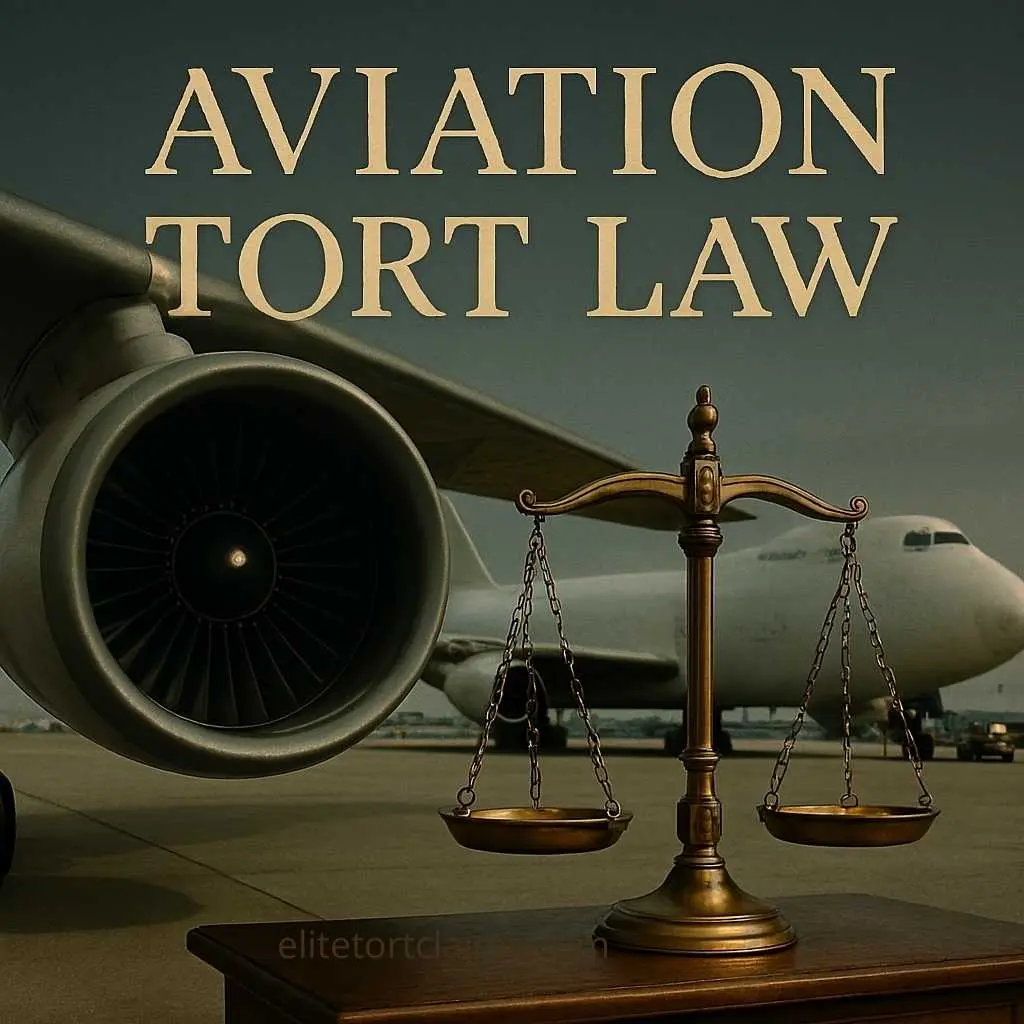
In 2026, aviation tort liability is increasingly focused on the intersection of software integrity and mechanical reliability.
When a technical failure leads to an incident, the burden of proof often shifts toward showing a breach in safety standards during the manufacturing or maintenance phases.
This requires strategic liability oversight to ensure that all parties, from software developers to airline operators, are held accountable for their roles in ensuring passenger safety.
Technical Failures and Professional Negligence
One of the most critical trends in aviation tort liability this year is the litigation surrounding AI-driven navigation systems.
Proving professional negligence in these cases is challenging, as it involves dissecting complex data logs and algorithm performance.
Legal teams must demonstrate that the technical failure was a foreseeable risk that the manufacturer failed to mitigate through proper safety protocols.
This data-heavy approach is now the standard in modern aviation tort liability cases.
Global Safety Standards and Jurisdiction
Because aviation is inherently global, aviation tort liability in 2026 often involves international treaties and cross-border legal challenges.
Much like the maritime issues we explored in Energy Sector Liability, flight accidents require a unified legal strategy to navigate different judicial systems.
Ensuring that professional negligence is addressed under the correct international safety standards is essential for victims seeking justice and fair compensation.
Strategic Risk Management for Airlines
To combat the rising costs of litigation, airlines are integrating Strategic Legal Risk Management into their daily operations.
By conducting real-time audits of flight data and maintenance records, companies can identify potential risks before they escalate into aviation tort liability claims.
This proactive commitment to corporate accountability not only improves safety but also strengthens the airline’s legal position in the event of an unavoidable technical failure.
In 2026, aviation tort liability cases rely heavily on the evolution of the ‘Digital Black Box.’
Beyond traditional flight recorders, modern aircraft now stream real-time telemetry data to cloud-based servers, providing immutable evidence of professional negligence or technical failure.
This transparency allows legal teams to conduct a more thorough strategic liability oversight, pinpointing the exact microsecond a system failed.
By utilizing this high-fidelity data, the legal accountability of manufacturers is no longer a matter of speculation but a matter of verifiable digital fact.
Passenger Protection & Redress
Ensuring that passenger rights are upheld in the face of complex technical failures remains a priority for aviation tort liability specialists.
As flight litigation becomes more globalized, victims require a legal framework that guarantees fair compensation regardless of the airline’s home jurisdiction.
This commitment to corporate accountability forces the aviation sector to maintain the highest safety standards, ensuring that professional negligence is met with swift and decisive legal action, thereby preserving public trust in the global aviation network.
Future Outlook: Space Tourism and New Liabilities
As we look beyond 2026, the horizon of aviation tort liability is expanding to include commercial space travel.
The professional negligence standards applied to traditional flights will soon be adapted for suborbital missions.
Staying ahead of these emerging trends is crucial for legal professionals who want to lead in the field of high-stakes liability oversight.
Q: What defines Aviation Tort Liability in 2026?
A: It is the legal responsibility of airlines and manufacturers for damages caused by technical failures, pilot error, or breaches in safety standards during flight operations.
Q: How do technical failures impact legal accountability?
A: Technical failures in software or hardware can be classified as professional negligence if it is proven that safety protocols were ignored during development or maintenance.
Q: Why is strategic liability oversight necessary for airlines?
A: It allows for proactive risk mitigation and ensures that the airline is prepared for complex international litigation following a technical incident.


No comment