this type of liability أو environmental misconduct.
Emerging Liability Trends in 2026
Table of Contents
The landscape of corporate environmental negligence has undergone a seismic shift in 2026.
As global climate policies tighten, legal frameworks are now more focused than ever on holding corporations accountable for their ecological footprint.
At Elite Tort Claims, we have observed that professional negligence in environmental management is no longer just a regulatory issue; it is a primary driver of high-stakes litigation.
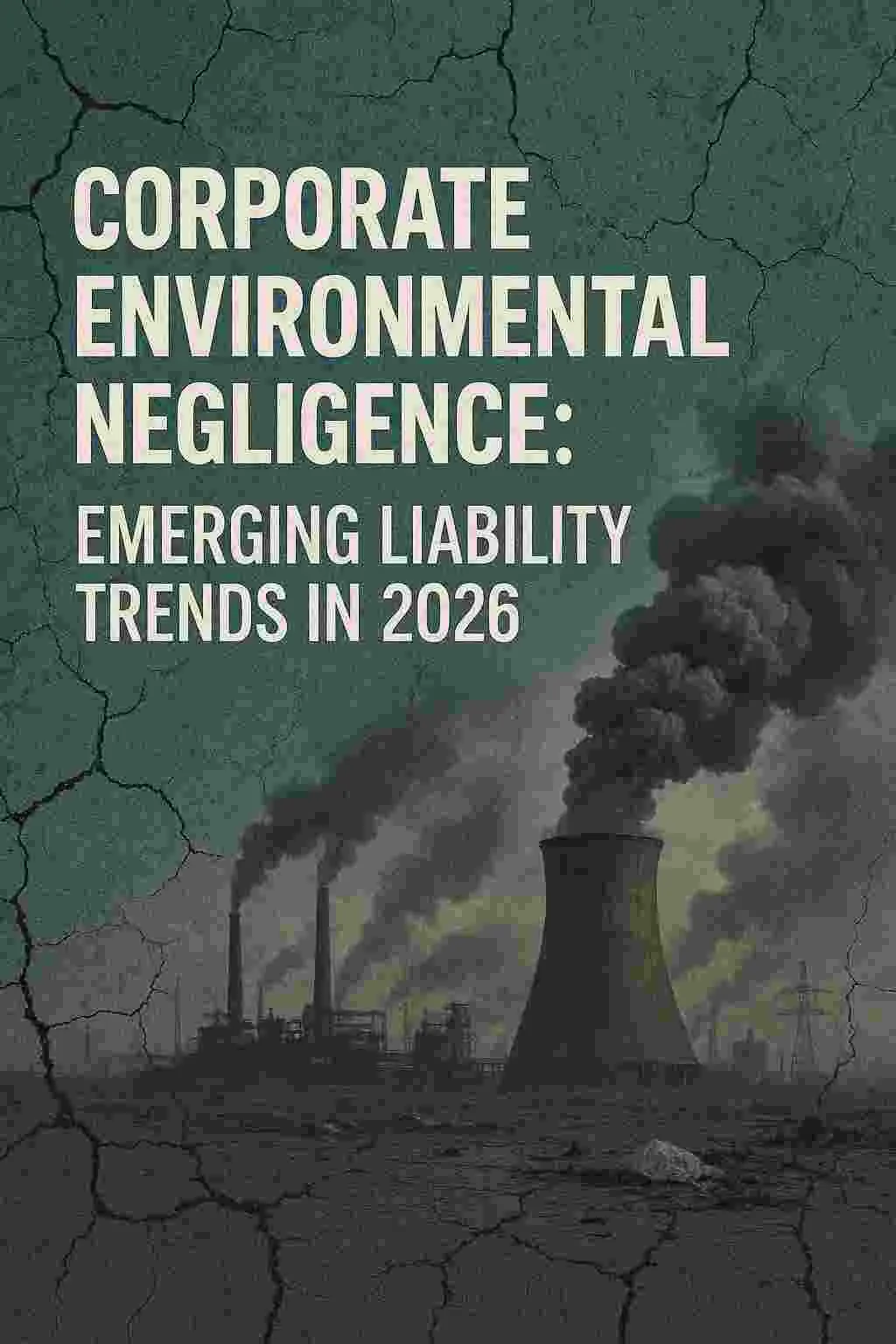
Understanding corporate environmental negligence requires a deep dive into the 2026 safety standards.
This year, courts are increasingly applying the “Polluter Pays” principle with unprecedented rigor.
Corporations are finding that traditional strategic legal risk management is evolving to include real-time environmental monitoring and data transparency.
Any failure in these areas is now categorized under corporate environmental negligence, leading to significant financial and reputational damages.
Technological Integration and LiabilityIn 2026, the rise of AI-driven environmental auditing has redefined the evidence used in corporate environmental negligence cases.
Legal professionals now utilize satellite imagery and IoT sensor data to prove professional negligence in chemical spills or air quality violations.
This technological integration ensures that corporate environmental negligence claims are backed by empirical data, making it harder for negligent parties to avoid responsibility.
The Intersection with Industrial Claims
There is a clear link between environmental failure and broader industrial issues.
Cases of corporate environmental negligence often overlap with Industrial Liability Claims, creating a complex web of tort litigation.
This intersection means that safety protocols must be holistic, addressing both human safety and ecological preservation to prevent charges of professional negligence.
The Intersection with Industrial Claims
There is a clear link between environmental failure and broader industrial issues.
Cases of corporate environmental negligence often overlap with Industrial Liability Claims, creating a complex web of tort litigation.
This intersection means that safety protocols must be holistic, addressing both human safety and ecological preservation to prevent charges of professional negligence, these ecological claims.
Victims of such professional negligence in 2026 are finding stronger legal protections.
New directives allow communities to file collective tort claims against major polluters.
Strategic litigation in these cases focuses on long-term health impacts and restoration costs.
For anyone pursuing corporate environmental negligence compensation, staying informed on these emerging trends is essential for a successful legal outcome.
Proving corporate environmental negligence in 2026 requires more than just evidence of a spill; it requires a direct link between professional negligence and long-term ecological degradation.
Courts are now demanding comprehensive ‘Environmental Impact Audits’ that span over several years to assess the full scale of liability.
For legal teams, this means that strategic risk management must include the hiring of specialized environmental scientists to provide expert testimony in corporate environmental negligence cases, ensuring that the evidence meets the high bar set by modern safety standards.
The social cost of corporate environmental negligence is another major factor in 2026 tort strategies.
Global corporations are under intense scrutiny from both the public and regulatory bodies to maintain transparency in their sustainability reports.
Any discrepancy in these reports can be used as evidence of professional negligence, potentially leading to massive class-action lawsuits.
This transparency shift is forcing industries to adopt more rigorous safety protocols, as the cost of corporate environmental negligence now includes irreparable damage to brand value and consumer trust.
As we evaluate corporate environmental negligence on a global scale, we see a movement towards harmonizing international liability laws.
In 2026, a corporation can be held liable in its home country for professional negligence that occurred in its overseas operations.
This ‘Cross-Border Accountability’ is a game-changer for corporate environmental negligence claims, providing a lifeline to communities in developing nations that were previously ignored.
It reinforces the fact that environmental protection is a universal legal obligation that transcends national borders.”
Future Outlook:
Sustainability and the Law Looking forward, this legal responsibility will continue to be a cornerstone.
As we move beyond 2026, the legal definition of professional negligence will expand to include failures in carbon credit management and greenwashing.
Companies that prioritize sustainability today will be best positioned to avoid the costly pitfalls of such ecological failures in the future.
Q: What defines corporate environmental negligence in 2026?
A: It is defined as a failure to meet updated ecological safety standards and professional negligence in pollution control.
Q: Can communities sue for corporate environmental negligence?
A: Yes, 2026 laws support mass tort actions for community-wide environmental damages.


[…] “which is similar to the challenges we analyzed in corporate environmental negligence“ […]
[…] “For more insights on how corporate accountability is evolving, explore our strategic review on Corporate Environmental Negligence 2026“ […]