Table of Contents
As the legal landscape of 2026 becomes increasingly integrated with high-tech industries, many people have complex questions about their rights and the nature of corporate accountability.
This FAQ guide aims to provide clear, institutional-grade answers to the most common questions regarding tort liability FAQ 2026 and the pursuit of justice in cases of professional negligence.
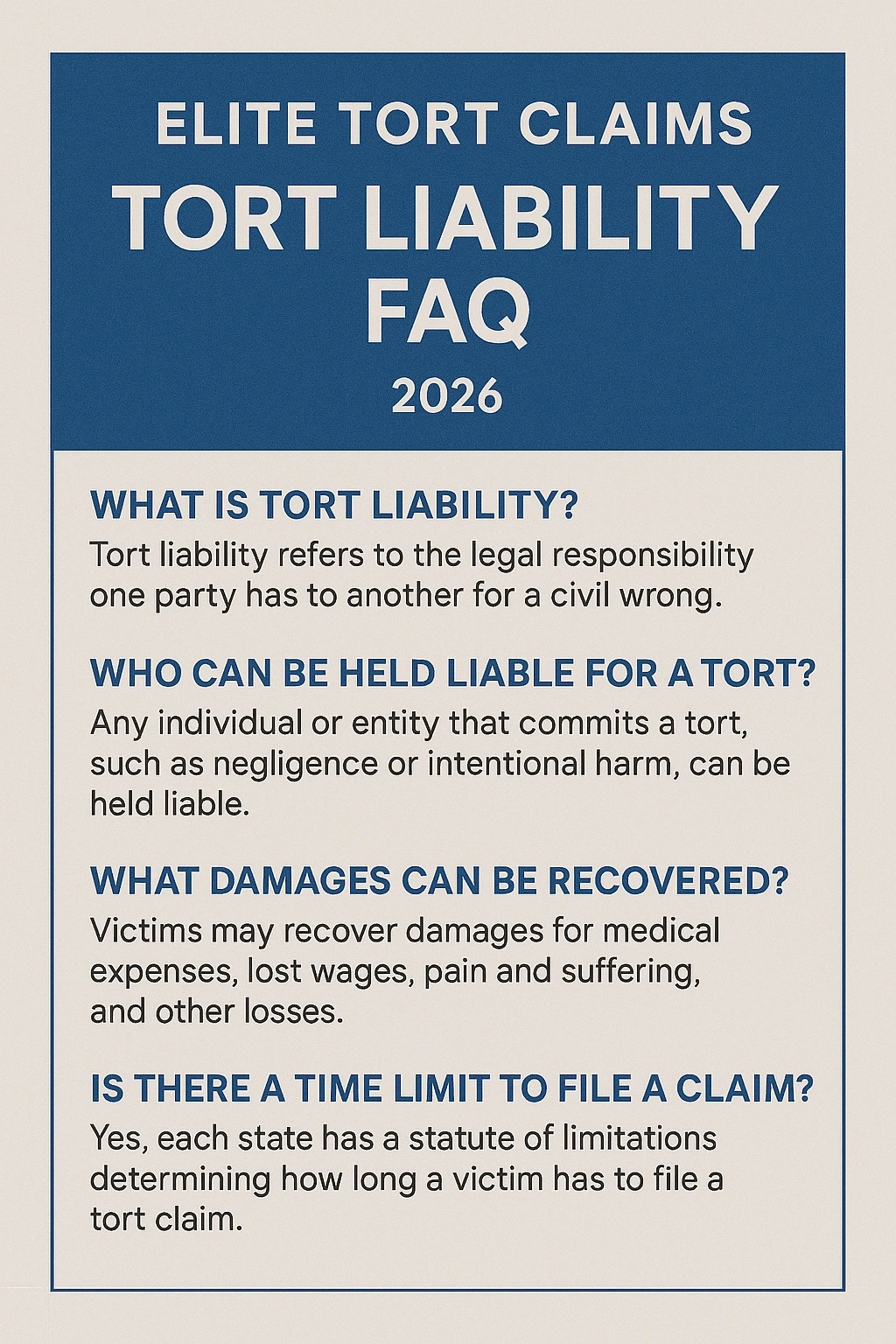
What defines the Framework of Tort Liability FAQ 2026?
In 2026, tort liability FAQ 2026 refers to the legal obligation of one party to compensate another for harm caused by a breach of duty.
This year, the definition has expanded to include “algorithmic duty of care,” where entities are responsible not only for physical actions but also for the outcomes of the AI systems they deploy.
Whether it is an industrial accident or a digital error, the core of tort liability remains the enforcement of safety standards and the protection of individual rights.
2. How do I prove Professional Negligence in a high-tech case?
Proving professional negligence now requires a combination of traditional legal expertise and forensic data analysis.
To succeed in a claim, one must demonstrate that a professional or entity failed to meet the established safety standards of their industry.
In 2026, this often involves using “Digital Twins” to simulate technical failures or auditing real-time logs to prove that strategic liability oversight was ignored.
Legal accountability is established when a direct link is shown between the failure to act and the harm suffered.
3. What are the key steps in an Aviation Tort Liability investigation?
Following a technical failure in flight, an aviation tort liability investigation follows a rigorous process:
Data Recovery: Analyzing black box data and cloud-based flight logs.
Forensic Engineering: Examining physical and digital components for defects.
Regulatory Audit: Checking if the airline or manufacturer adhered to international safety standards.
Liability Mapping: Determining if the professional negligence occurred during manufacturing, maintenance, or operation.
This comprehensive approach ensures that corporate accountability is assigned correctly, regardless of the complexity of the flight systems involved.
4. Can a company be held liable for software glitches in 2026?
Absolutely.
Under the current tort liability FAQ 2026 framework, software is treated as a critical component of a product’s safety profile.
If a software glitch leads to property damage or personal injury, it is often classified as a manufacturing or design defect.
Companies are now expected to maintain strict strategic liability oversight throughout the software’s lifecycle, ensuring that updates do not introduce new risks to consumer safety.
5. What is the role of Strategic Legal Risk Management for corporations?
Strategic Legal Risk Management is a proactive discipline used by corporations in 2026 to identify and mitigate potential tort liability FAQ 2026 exposures.
By integrating compliance monitoring into their core operations, firms can detect professional negligence before it results in a lawsuit.
For the public, this means safer products and services; for the company, it ensures a higher level of legal accountability and brand protection.
6. Are there specific time limits for filing a Product Liability claim?
Yes, these are known as “Statutes of Limitations.
In 2026, these limits vary depending on the jurisdiction and the type of product involved.
However, for most product liability claims, the clock starts the moment the defect is discovered or should have been discovered.
It is crucial to act quickly to ensure that forensic evidence is preserved and that your right to legal accountability is not lost due to procedural delays.
7. How does Public Sector Tort Liability differ from private sector claims?
While private sector claims focus on corporate accountability,
Public Sector Tort Liability involves holding government entities responsible for their actions.
In 2026, the key difference lies in the specific legal frameworks and administrative procedures required to sue a state-funded body.
Despite these complexities, the standard for professional negligence remains high, ensuring that public safety standards are upheld for all citizens.
Conclusion
Navigating the world of tort liability FAQ 2026 can be challenging, but understanding your rights is the first step toward justice.
By focusing on professional negligence and corporate accountability, the legal system continues to adapt to the technical failures of the modern age.
If you have further questions, our team at Elite Tort Claims is dedicated to providing the strategic analysis you need to understand the global litigation landscape.
8. What are the Emerging Trends in 2026 Litigation?
The most critical trend identified in this tort liability FAQ 2026 is the shift toward preventive accountability.
Corporations are no longer just reacting to lawsuits; they are implementing real-time risk mitigation strategies to uphold high safety standards.
This proactive stance is essential for maintaining corporate accountability in a world where technical failures can have global repercussions.
As legal frameworks continue to evolve, staying informed through a detailed tort liability FAQ 2026 is the best way for both professionals and consumers to navigate the complexities of modern law.

No comment